
Insights
Moving from Principles to Practice
- A Practical Resource for Applying Social Equity and Gender Equality in Investment
By Laura Groggel (Kore Global) and Kate Gatto (Realize Capital Partners)
May 2026
Integrating social equity and gender equality into investment practice is not just the right thing to do -- it's good for business. There is a large body of evidence that backs this up: Across 15 studies over two decades, companies with gender-diverse executive teams were 25% more likely to achieve above-average profitability compared to peers.
As shown below, a portfolio analysis of Calvert Impact Capital's investments in 160 businesses globally found that companies in the top quartile for women in leadership outperformed bottom-quartile peers on returns on sales (18.1% vs. -1.9%), returns on assets (3.9% vs. 0.3%), and returns on equity (8.6% vs. 4.4%).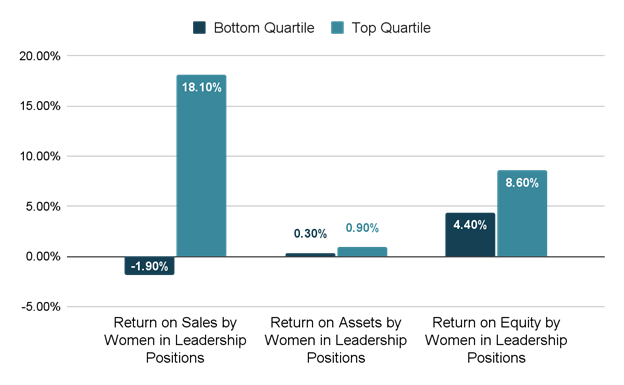
The case for racial equity is equally compelling. Companies that proactively hire racially and ethnically diverse staff are 35% more profitable than those that don't (World Economic Forum, 2023). Despite the current political climate, which in many cases is leading investors and other market actors to shift away from strategy that centres social equity and gender equality, the evidence shows that these actions actively limit productivity, creativity and innovation – with real economic consequences.
Organizations that adopt strong practices across the dimensions of social equity and gender equality tend to build more resilient governance structures, develop more market-responsive products and attract a broader range of mission-aligned capital. Yet despite this, and despite stated intentions – genuine in many cases – many practitioners working in impact investing, social finance, philanthropy, and social purpose still find it difficult to translate social equity and gender equality principles into policies and day-to-day practices that shape organizational culture leading to positive social outcomes and business results.
The question isn't whether equity matters. It's how to do the work consistently and authentically in a way that holds up to scrutiny and doesn't collapse into compliance checkbox exercises.
This is what the Pilot Social Equity Lens Investment (SELI) Coding System is designed to address. Developed as part of Canada's Social Finance Fund (SFF) by the Government of Canada, SELI is Canada's national framework for social equity and gender lens investing. Building on established global frameworks like the 2X Criteria, it functions simultaneously as an assessment tool and a roadmap. As an assessment, it gives actors across the capital chain – wholesalers, Social Finance Intermediaries (SFIs), and Social Purpose Organizations (SPOs) – a structured way to classify investments as Social Equity Lens Investments or Gender Lens Investments based on established criteria across themes like portfolio alignment, leadership, and organizational culture. As a roadmap, it helps organizations track their own progress over time, not just where they are today, and offers pathways for them to deepen their practices to realize the actual value that intentional equity-focused practice offers.
Ultimately, these practices are not abstract: They shape who has access to capital, who is represented in leadership, and the profile of economic opportunity in Canada.
To support people to apply the framework, we have developed the SELI Learning Module – a practical capacity-building resource designed to build clearer understanding of how the SELI Coding System can be interpreted and applied in real investment and reporting contexts.
The SELI Learning Module introduces the SELI Coding System and demonstrates how it can be applied across investment and reporting processes. It was designed primarily for SFIs and SPOs with investment in the SFF, but the underlying questions it tackles – how to assess and advance social equity and gender equality practices with rigor and consistency, how to think about evidence and intentionality, how to support organizations at different stages – are relevant well beyond the SFF. It is our hope that practitioners in impact investing, social finance, philanthropy, and social purpose broadly will find SELI and this learning module useful and we encourage you to apply the flexible framework in your context.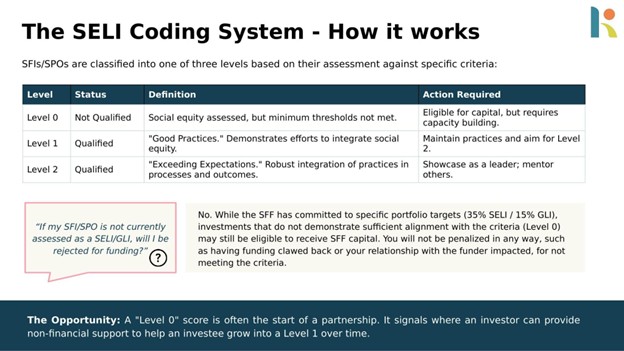
Across social finance, there is increasing pressure to demonstrate economic reconciliation with Indigenous communities and progress towards outcomes related to equity and justice for those who continue to be structurally excluded from access to capital, including Black and other racialized communities, and gender-diverse people. This pressure is well-founded. Despite a growing body of compelling evidence, capital deployed with a social equity and gender lens still represents a small fraction of total investment globally, and the gap between stated commitments and measurable action remains wide.
This gap persists in part due to a lack of practical tools to act. Research across the sector consistently finds that even investors persuaded by the business case often lack the frameworks and support needed to move from intention to consistent practice. Deeply rooted systemic biases and structural barriers, resistance to changing established processes that reproduce inequitable outcomes, and the absence of sector-specific, contextualized data all slow adoption. Closing this gap requires intentional, sustained effort from actors across the capital chain. Let’s close the gap together: Explore the SELI Learning Module.
Over the next year, we plan to release additional resources and to host conversations online and at conferences and events about applying the SELI Coding System in practice with people doing the work. Join us on June 9 for a conversation about integrating community voice in investment decision-making. The webinar is designed around one SELI theme with practical examples and moderated discussion with panelists about how participatory approaches can be embedded across governance, due diligence, and capital allocation, and how these practices support stronger gender equality and social equity outcomes. Register for the webinar today.
RELATED RESOURCE
WEBINAR
Learn more about SELI and how fund managers are embedding community voice in investment decision-making across Canada
June 9, 12:30pm Eastern
In 2026 at Realize Capital Partners and at our fellow wholesalers, Social Finance Fund investees reported to us, and we reported to the Government of Canada using the SELI Coding System for the first time. We appreciate the accountability to social equity and gender equality that the tool promotes, and the opportunity for deepening practices that it presents. The work that Kore Global is leading will support SFIs and SPOs to apply SELI as an assessment and reporting tool; and to deepen their practices, meeting stakeholders where they are with a responsive, context-specific approach. We are excited about this partnership and look forward to continuing to support this important work.