
Insights
Beyond the Pitch: How Multiple Forms of Capital Are Shaping Canada’s Nature-Finance Market
Authored by: Nature Investment Hub & Realize Capital Partners
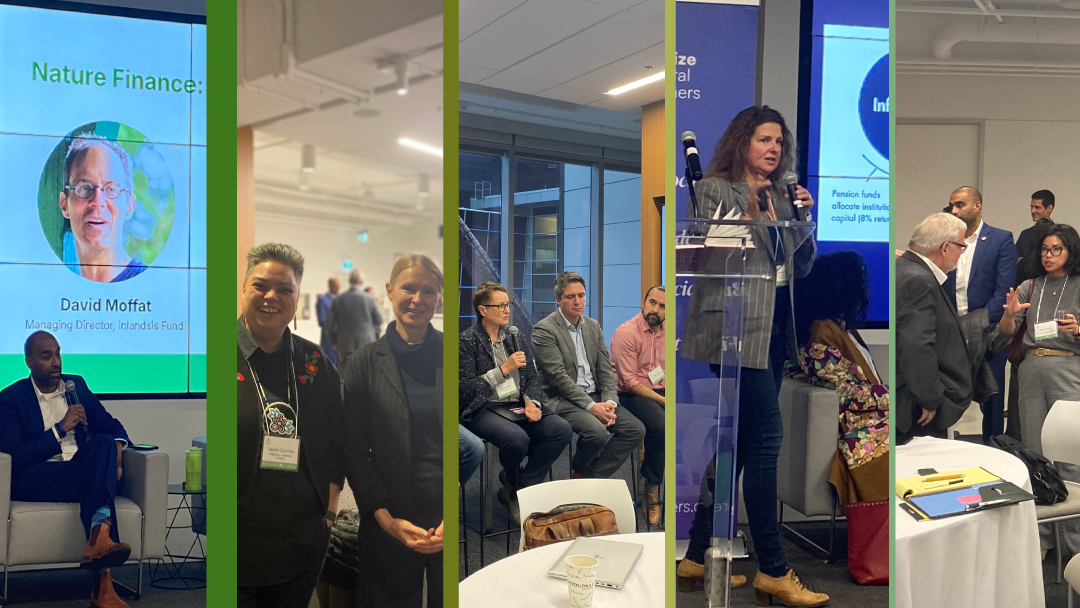
On November 25, against the backdrop of Canada’s first‐ever Canada Climate Week Xchange, the Nature Investment Hub and Realize Capital Partners co-convened The Nature Pitch: Funding the Future of Nature-Based Climate Solutions in Canada – a half-day gathering focused on advancing investable solutions for nature. The event was generously hosted by TELUS in Toronto.
The Nature Pitch event was designed to build awareness of emerging trends in the nature finance market in Canada and to showcase investment models and concepts that require financial capital to scale. Yet, as many of us know, a necessary condition for market-building is also human and social capital: the exchange of knowledge and the relationships that carry these models forward.
With 75 individuals in the room, we felt the richness of these multiple forms of capital coming together. With this reflection in mind – and for those who were not able to join us – we revisit the flow of the event and the breadth of voices that shaped the conversation, and also share 10 takeaways.
Opening and Keynote
We were grateful to have Bob Watts, Reconciliation Practitioner and Knowledge Keeper, travel from his home at Six Nations Reserve to join us for the afternoon. In opening the event, Bob grounded the conversation in the inherent responsibility Indigenous Peoples hold in caring for the land and the central role of Indigenous stewardship in conserving and restoring biodiversity. In doing so, he also emphasized reciprocity and reconciliation among people and with the land.
In his keynote, Member of Parliament Eric St-Pierre, expressed his interest in blended finance and nature finance opportunities and his intent to be an ally and advocate on these topics within government. He highlighted the role of policy and regulation in stimulating investment and the importance of increasing awareness within government around instruments such as outcome-based contracts to strengthen the market, extending an invitation to those in the room to engage directly with the government to build this internal capacity.
Takeaway 1: Centring reconciliation, reciprocity, and responsibility as we build a nature finance market for Canada
From a nature finance perspective, reconciliation, reciprocity, and responsibility are not abstract values but foundational design principles for how capital can be structured, governed, and deployed. As we were reminded, giving back to Mother Earth calls for reconciliation not only among peoples, but with the land itself, requiring finance to move beyond extractive models toward regenerative ones. It means Canadians thinking about their own relationship with nature, and our shared responsibility to actively support Indigenous stewardship.
Takeaway 2: Public Policy that Enables High-Integrity Markets
The importance of government leadership in providing clear, enabling policy and regulatory frameworks for high-integrity nature markets was emphasized throughout the event. An example was shared of a promising opportunity set of First Nations-led projects in British Columbia that are currently stalled due to delays in advancing Atmospheric Benefits Sharing Agreements. Ongoing ambiguity around asset rights discourages capital – especially from smaller investors who do not always have the time or resources to navigate unresolved governance and instead seek opportunities in lower-friction jurisdictions.
Panel – Nature Finance: Insights and Emerging Trends
A panel discussion on emerging trends in nature finance featured insights from Hari Balasubramanian (EcoAdvisors), Valérie Courtois (Indigenous Leadership Initiative), and David Moffat (Inlandsis Fund). The panel drew on their respective experience working at the global level in nature finance, managing and deploying capital for nature and climate, and leading a national movement in Indigenous-led conservation and stewardship across Canada.
Speakers underscored Canada’s leadership role in shaping the global consensus on nature and the opportunity this opens up to lead on nature finance, alongside the urgent need to centre Indigenous leadership, enable innovative and blended finance, and strengthen policy and regulatory frameworks.
Takeaway 3: Governance, Rights & Indigenous Leadership Are Central to Investability
A clear through-line emerged that who leads, owns, governs, and benefits matters. Indigenous peoples must be recognized as rightsholders and shareholders, not as stakeholders. This means embedding reciprocity into investment structures through fair benefit-sharing. We also heard the need to ensure more Indigenous voices, including Guardians and land-based stewards, are present and centered in rooms where knowledge is shared, deals are designed, capital allocation decisions are discussed, and policies are shaped.
Trust is also core market infrastructure and must flow both ways, requiring a building of trust and confidence in investors / institutions and Indigenous governance systems.
Takeaway 4: Scaling Nature Finance Requires Clear Cashflows and Valuation of Environmental Attributes
Nature remains deeply undervalued in our economic system. As we heard, carbon markets have helped make parts of nature visible in financial terms, but they offer only a partial and imperfect solution. A fundamental shift in policy, regulation, and economic accounting is required to properly recognize, value, and protect living ecosystems as the foundation of long-term prosperity.
We also heard while carbon markets remain the most active entry point for private capital today, there is growing interest in biodiversity credit markets. Canada has the potential to play a leadership role in accelerating the adoption of these ‘beyond-carbon’ markets.
Takeaway 5: Canada Is Uniquely Positioned to Lead
Canada was described as uniquely positioned to lead globally on nature finance. With a vast land base, strong Indigenous stewardship, pools of institutional capital, and a clear roadmap under the Global Biodiversity Framework, the ingredients for leadership already exist. The creation of a Secretary of State for Nature is a strong signal that nature is being given a political home and explicit accountability. The expected forthcoming announcements of the federal government’s nature-specific strategy will be an important next step in moving from signals to action.
Takeaway 6: Valuing Nature Is a Demand Problem as Much as a Supply Problem
As we heard, a central challenge remains a limited willingness to pay for nature outcomes, driven in part by weak and carbon-only compliance markets and uneven corporate demand. Without strong buyers, even well-designed nature investment products struggle to become investable at scale. Despite widespread corporate net-zero commitments, near-term demand for nature-based outcomes remains limited – especially with many targets pushed out to 2050. The market needs more corporate leadership and near-term purchasing commitments to unlock projects.
Framing nature through the lens of catastrophic risk – including flooding, erosion, methane, and wildfire – was said to be effective in engaging institutional investors.
Takeaway 7: Nature is a Unifying Force
Nature continues to be recognized as a shared point of connection across sectors and ideologies. As we heard one speaker say “there are no ‘nature deniers’”. In an era of division, particularly around views on climate change and sociocultural values, nature continues to be a galvanizing force that brings people together. This is part of the rationale behind The NAT – a new global movement meant to reconnect people with the awe-inspiring power of the natural world and unite them to drive real, measurable change through accelerated investment into nature.
Pitch Presentations
The main showcase featured five concise presentations on investable solutions across forest and land conservation, sustainable food systems, and urban green spaces. While these opportunities are early in their raising journey and/or relatively small in size (some are still finalizing their concept) they are promising, demonstrating the potential for returns, measurable impact, and strong community and ecological outcomes.
- Bloom Impact Capital (Eoin Callan, Bloom Impact Capital)
- Conservation Impact Bond (Jo Reynolds, Carolinian Canada)
- Civic Infrastructure Bond (Anastasia Mourogova Millin, DanSa Capital Innovation & Ombrello Solutions)
- Living Forest Fund (Pete Corke, Kwaxala)
- Shared Ownership Concept (Derek Leahy, Rural Routes to Climate Solutions)
We invite you to read more about each of the solutions showcased here.
Following the five presentations, Joelle Faulkner (Area One Farms) and Philippe Crete (Fondaction Asset Management) offered reflections to help pitch presenters strengthen their narrative, refine their concept, and better understand what resonates from an external perspective.
Takeaway 8: A Timely Opportunity for Early-Moving Capital to Scale Nature-Positive Innovation
The concepts and models presented at the event reflect a high degree of innovation. While most opportunities remain early-stage and many under $100M in target size, this creates a timely opportunity for catalytic and early-moving capital, in particular from philanthropic foundations, government and crown corporations, and family offices, to help these models scale toward institutional readiness. While only one of the five strategies on display included an explicit focus on a blended finance capital stack, there is an opportunity for blended, concessionary or catalytic capital to accelerate institutional participation.
Takeaway 9: Nature as a Portfolio Asset
Market realities mean that nature-related investments must be competitive with conventional asset classes, particularly in an inflationary environment with increasingly conservative investment decisions. At the same time, emerging examples as showcased at the event demonstrate that nature investments can offer meaningful diversification, unique risk-return profiles, and long-term resilience by reducing exposure to climate, physical, and systemic risks.
Takeaway 10: Visibility Through Cross-Sector Convening
The event underscored the value of and need for more deliberate spaces to surface and showcase nature finance opportunities. Many promising solutions are not as widely known as assumed. Cross-sector convening that brings unfamiliar actors into the same room is a key enabler of investment and collaboration.
This blog, co-authored by Realize Capital Partners, is for informational purposes only and does not constitute investment advice or a recommendation, offer, or solicitation to invest in any opportunity, product, or strategy described.